Education Reform Part 1: The Spark
Updated: Apr 22
Part 1: The Architect of Enlightenment
Before understanding the specific policies that transformed Baroda State, we must understand the man behind them. Sayajirao Gaekwad III’s reforms weren't just political mandates; they were born from a profound personal metamorphosis.
The Farm Boy King
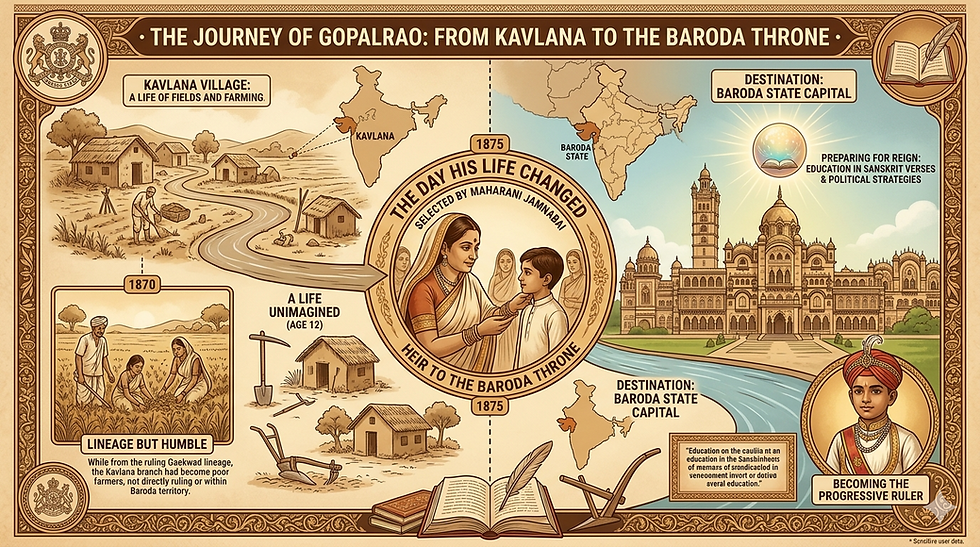
Before he was a Maharaja, he was Gopalrao, a 12-year-old boy living in the village of Kavlana. His world was defined by the rhythm of the fields, far removed from the Sanskrit verses and high-stakes diplomacy of the royal court. Although his family shared the Gaekwad lineage, they lived as humble farmers outside the Baroda State territory.
In 1875, his life changed in a single afternoon. Maharani Jamnabai, seeking an heir to the throne, selected the young Gopalrao. Upon entering the Laxmi Vilas Palace, the "knowledge gap" was staggering. While other princes were groomed from birth, Gopalrao was illiterate.
He was immediately thrust into a rigorous educational audit of his own life. For nine hours a day, he mastered English, Marathi, Gujarati, and History. This "crash course" was a revelation. He realized that the only thing separating the boy in the fields from the King on the throne was access. This became the "Source Code" for his reign: if education could transform a farm boy into a scholar-king, it could transform the entire Baroda state.
The Global Student's Inspiration
While his contemporaries often traveled to Europe for leisure and luxury, Sayajirao traveled as a modernization scout. He looked at the world through the eyes of a social architect:
During his visits to the United States, he was fascinated by the "common school" movement. He observed that literacy was the fuel for the American Industrial Revolution. To him, education wasn't an elite luxury; it was national infrastructure.
He was deeply moved by Japan’s Meiji Restoration. Japan had transitioned from a feudal society to a global power in mere decades by making primary education compulsory in 1872. He famously remarked that if Japan could rise through the classroom, Baroda had no excuse to remain in the dark.

The "Thinking State" Philosophy
Sayajirao was a pragmatic economist who understood that a state is only as strong as its average citizen. His goal was to replace "blind superstition" with Scientific Temper.
He envisioned a "bottom-up" modernization. By educating the masses in remote villages like Sankheda and Bahadarpur, he wasn't just teaching children to read; he was building a decentralized "Civil Service." He knew that for the Village Panchayats to be effective, the people needed to be literate enough to audit their own books and manage their own local governance.

"The education of the people is the only foundation on which we can safely build the edifice of our social and political progress." — Sayajirao Gaekwad III, 1906
The policies implemented by Sayajirao III, which we will discuss in detail in other posts, affected my grandparents on both sides significantly.
Comments