Part 4: Migration in Human Form
- Sheel Shah
- Jun 5
- 3 min read
From Celestial Sages to Earthly Merchants: The Grounding of the Valakhilyas
Every great lineage has a defining moment where survival demands a radical shift. For the Valakhilya Brahmins, that moment wasn't just geographical—it was physical, spiritual, and existential.
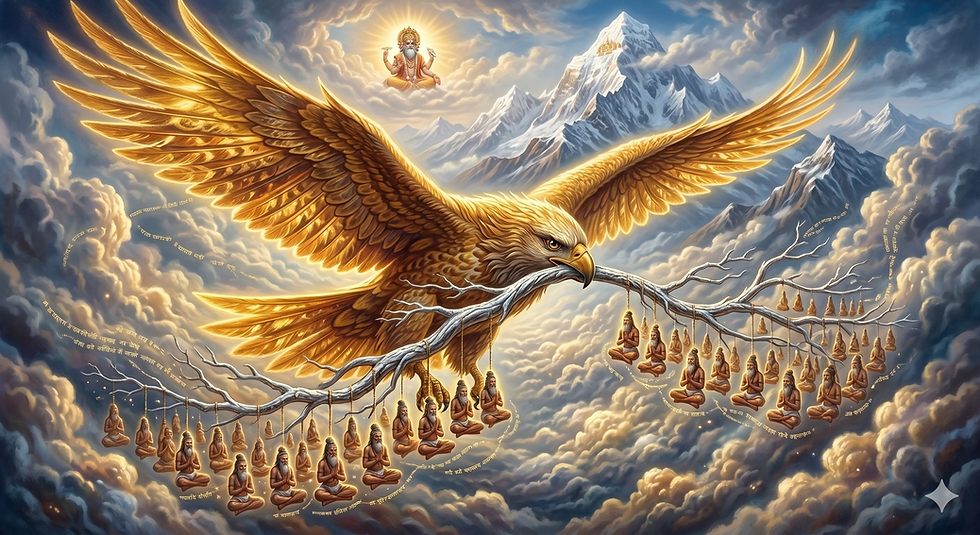
As the spiritual density of the Earth shifted during the transition from the Treta Yuga to the Dvapar Yuga, these thumb-sized, celestial ascetics faced a crisis. Living in high-altitude Himalayan isolation, sustained only by Soma (moon nectar) and air, the 60,000 celibate sages had no children.
They held a monopoly on the Valakhilya Sakha—a unique, powerful branch of the Vedas. If they simply "dissolved" back into the sun at the end of their cosmic tenure, this irreplaceable divine knowledge would vanish from the Earth forever.
Here is the incredible story of how they traded their celestial stature for human form to save their legacy.
1. The Divine Crisis and the Command of the Rishis
Seeing the imminent danger of the "Vanishing" Veda, Lord Brahma and the Saptarishis (the seven great sages) grew deeply concerned. A council of sages, led by Sage Kashyapa, approached the tiny ascetics with a radical proposition for the welfare of humanity (Loka-Kalyana): They had to transition from Sanyas (asceticism) to Grihastha (the householder life).
The Reluctance: The Valakhilyas resisted. Their miniature size was a badge of absolute purity; it allowed them to hang from trees, consuming virtually none of the Earth's resources. They feared that adopting standard human bodies would burden them with the heavy weights of ego, physical desire, and worldly illusion.
The Divine Compromise: To ease their fears, it was decreed that those who descended to the plains to marry and start families would be granted a "Body of the Earth" (Prithvi-Kaya). This physical transformation was a functional necessity—their tiny celestial forms simply couldn't handle the physical demands of householder rituals, such as tilling the land or maintaining massive sacrificial fires.

2. The Descent and the "Weight" of the Earth
Choosing duty over isolation, a group of Valakhilyas began a historic southward migration toward the banks of the Narmada River and the fertile plains of Gujarat.
As they walked away from the high peaks, their physical constitution began to alter. The transition wasn't a sudden, monstrous mutation, but a gradual "grounding" process driven by environment and diet. In the Himalayas, they survived on air; in the plains, they began to consume the grains and water of the Earth. Slowly, the physical elements of the dense world integrated into their biology, giving them the standard human form we recognize today.
The Loss of Stature: Taking a human form was technically a loss of their celestial, untainted stature. Yet, it was the ultimate act of sacrifice. They lowered their physical vibration so that the Valakhilya Sakha could survive through human lineages. This transformation is central to the history of the Zarola Brahmins and regional Gujarati traditions, as detailed in the Valakhilya Puran.

3. The Career Pivot: From Priests to Mahajans
The migration didn't stop at a physical transformation. As the eras rolled on, environmental realities forced another profound shift. Facing severe droughts and changing socioeconomic landscapes, the community realized that purely relying on priestly duties was no longer viable for survival.
To adapt, they executed a brilliant career pivot: moving from strict priesthood to becoming administrators and merchants (Mahajans).

This conversion to the mercantile class wasn't a abandonment of their roots—it was a strategic defense mechanism. By mastering commerce, they generated the wealth required to:
Survive harsh environmental collapses and droughts.
Fund their own spiritual duties (Dharma).
Protect and preserve their Vedic heritage without being at the mercy of volatile royal patronage.
The entire group did not convert over to Vaniya. Part of the group remained Brahmin. This was viewed as a sacrifice of some of the group.
The Takeaway: Adapting to Protect the Sacred
The journey of the Valakhilyas is a masterclass in conscious adaptation. They teaches us that true spirituality isn't rigid; it is fluid. When the survival of their sacred knowledge was threatened, they did not stubbornly cling to their celestial forms or their priestly roles.
Instead, they used commerce as a shield to protect spirituality. Even as they took human form and entered the bustling marketplaces as merchants, their souls remained anchored to the mountains. This is beautifully mirrored in The Enduring Worship of Himjamata—the deity whose worship traveled with them all the way from the snowy peaks of the Himalayas down through their southward migration, serving as a permanent spiritual compass for a changing people.


Comments