The Divine Origin of the Zarola: Part 1
- Sheel Shah
- May 14
- 3 min read
Where were the Zarola during Vedic times?
What is the origin story of the Zarola?
The story of the Zarola community is not merely a tale of migration; it is a cosmic chronicle that begins at the very dawn of creation. To understand the roots of the Zarola, we must look beyond the physical world to the mind of the Creator himself, Lord Brahma, and a unique group of thumb-sized sages known as the Valakhilyas.
The Mind-Born Progenitors
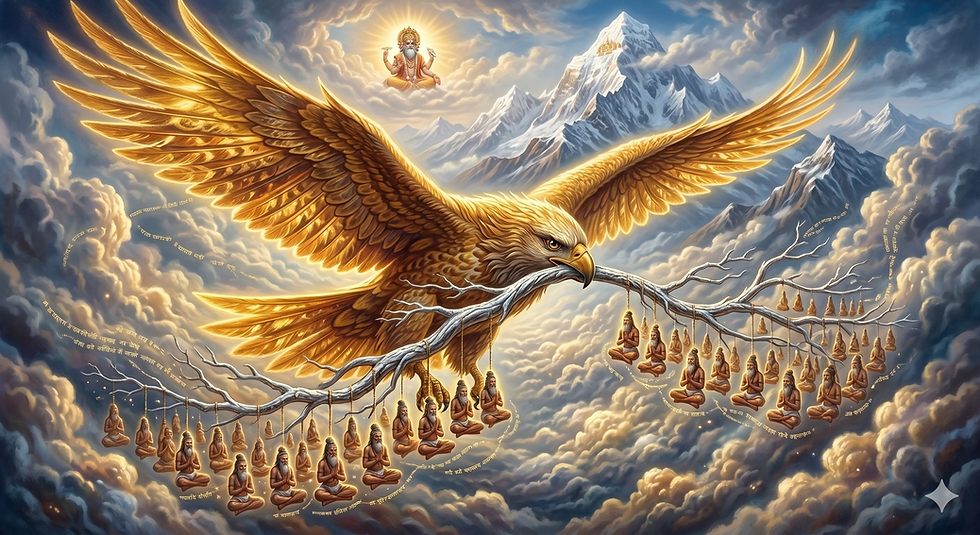
In the beginning, to populate the universe and establish the eternal wisdom of the Vedas, Lord Brahma created several Prajapatis or progenitors from his own mind. Among these was Prajapati Kratu. It is from Kratu that the lineage of the Valakhilyas — the ancestors of the Zarola — emerged. Unlike most beings, the Valakhilyas did not experience a biological birth. According to the Srimad Bhagavat and the Valakhilya Puran, they were born from the pores of the skin or the hair follicles of Kratu during a massive cosmic ritual. They were born as a collective of 60,000 rishis, each no larger than a thumb (Angusth-matra).

"Despite their diminutive size, the Valakhilyas possessed the brilliance of the sun itself. They were described as 'pure fire' or Tejas, embodying a spiritual intensity that far exceeded their physical form."
The Guardians of the Solar Sphere
Immediately upon their emergence into the cosmos, Brahma assigned these sages a critical duty. They were placed in the Solar Sphere to accompany Surya, the Sun God, on his daily journey across the sky. This was not a ceremonial role, but one of vital importance for the survival of the Earth. Surya’s heat was so intense and raw that it threatened to incinerate the Earth and all life upon it. The 60,000 Valakhilyas surrounded the sun’s chariot, walking in front of it while chanting the Veda Mantras. This collective chanting acted as a "spiritual filter," cooling the sun’s rays so that only life-giving light—and not destructive fire—reached the world below. For aeons, they served as the invisible shield between the heavens and the Earth.

Descent to the Himalayas
As the ages progressed, the Valakhilyas sought to deepen their connection to the Earthly plane. They ended up on the Himalayas, specifically the region of Mount Gandhamadana. (Part 2) It was during this period, that they lived as a single, massive collective of sages, existing in a state of pure Vairagya (detachment). They followed the highest traditions of the Brahmins, surviving on nothing but air and the "essence of the moon" (Soma). They also conducted a penance to have the emergence of Himja mata. (Part 3)
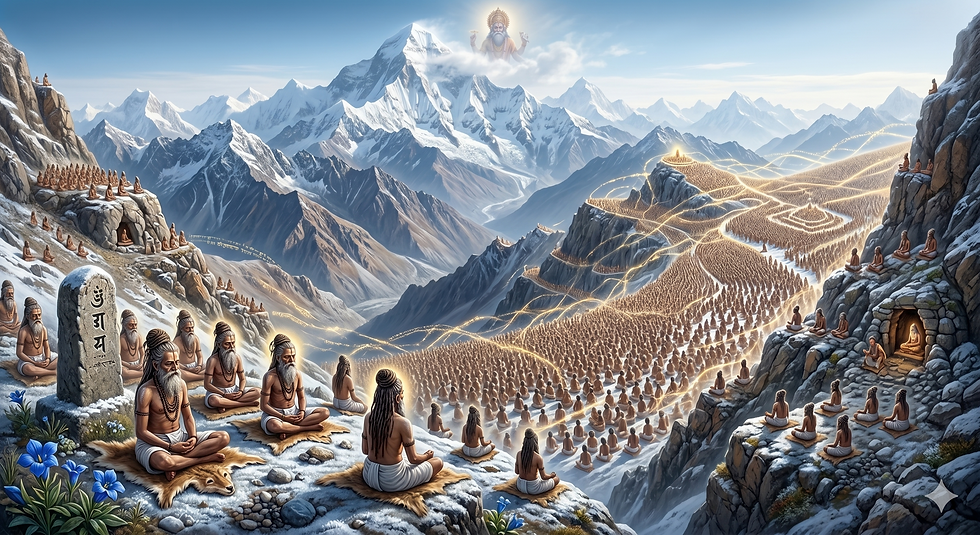
The divergence from being purely "celestial thumb-sized sages" to a "settled Brahmin community" is tied to the movement of Vedic culture across India. As groups of Brahmins moved toward the fertile regions of the Narmada River and eventually Gujarat, a specific branch of these sages was tasked with maintaining the Valakhilya Sakha (their specific branch of the Vedas) in the physical world. Legend suggests that those who chose to become householders (Grihasthas) to preserve the lineage gradually took on standard human proportions over generations, while those who remained in the Himalayas as ascetics retained their original thumb-sized, semi-divine forms.
Importance to Blog:
The Valakhilya were the ancestors of the Zarola. The starting point on Earth would be Himalayas and the migration began from there. This is where the emergence of Himja mata occurs. She attaches herself to this community. At some point they took on human form and decided to become householders. They were all Brahmin and then there was some external circumstance that required a group to start earning money for the rest of the group for sustainance and preservation. This how the Zarola Brahmin and Zarola Vaniya formed. The creation and migration of the Zarola is documented in the Valakhilya Puran. Key Takeaway: Even the smallest beings can hold the greatest responsibility for the universe.


Comments