Staggered Generations
Updated: Apr 21

During the early 1900s in Gujarat, to have a Mother-in-Law and Daughter-in-Law pregnant at the same time was so common. in traditional Gujarati joint families (during that time period) that it had its own name: Sasu-Vahu no Garbh (the simultaneous pregnancy of mother-in-law and daughter-in-law).
Was this a point of embarrassment for the family? Was the public saying anything to them?
The "Staggered" Births: A Story of Survival
My great grandmother, Manchaba, gave birth to 3 sons that were 10 to 12 years apart. This pattern of pregnancies was remarkably staggered. What were the potential environmental causes for this? This phenomenon of "staggered" births and overlapping generations was remarkably prevalent in late 19th and early 20th-century India. Far from being an isolated occurrence, it was a defining feature of the traditional joint family system, driven by a combination of biological, environmental, and cultural factors. My great-grandparents, Manchaba and Magandada, most likely had a child marriage, which was common occurrence during that period.
The most significant factor in this 12-year gap was the series of disasters that devastated Gujarat between 1870 and 1910:
The Chhappanio Duskal (1899–1900): Named after the Vikram Samvat year 1956, this was perhaps the most acute famine in the history of the Baroda State. A failed monsoon led to a total harvest collapse and a staggering 15% population decrease in the region. Famine drastically reduces fertility and increases miscarriages. If Manchaba had pregnancies between 1899 and 1902, it is likely the children did not survive the extreme malnutrition or the subsequent cholera outbreaks.
The Survival Advantage: As a merchant family, they likely had the capital to buy grain even as prices skyrocketed. This resilience is likely why Manchaba remained healthy enough to eventually give birth to my grandfather, Mohanlal, in 1907.
The Malaria: The 1900 monsoon brought a catastrophic malaria epidemic. Because the preceding dry years had reduced exposure to mosquitoes, the population had lost its partial immunity to Plasmodium falciparum. The resulting epidemic attacked "all classes," including the Bania community.
Plague Epidemics: By the time Mohandada was born in 1907, the bubonic plague (which started in 1897) was peaking in India (killing 1.2 million that year alone). In rural Baroda, disease outbreaks often wiped out "middle" children, leaving only the eldest and the "miracle" youngest survivors

A Daughter as "Ghar ni Laxmi"
One might wonder if the gap was due to gender preference, but the history of wealthy merchant families suggests otherwise. For a family of their standing, a daughter was celebrated as "Ghar ni Laxmi" (the Goddess of Wealth in the home). Furthermore, for Hindus, the act of Kanyadaan (giving a daughter in marriage) was a sacred duty and a source of immense social and spiritual prestige (punya).
Two Different Indias
The "staggering" of these births meant Manchaba raised two completely different types of Indian men:
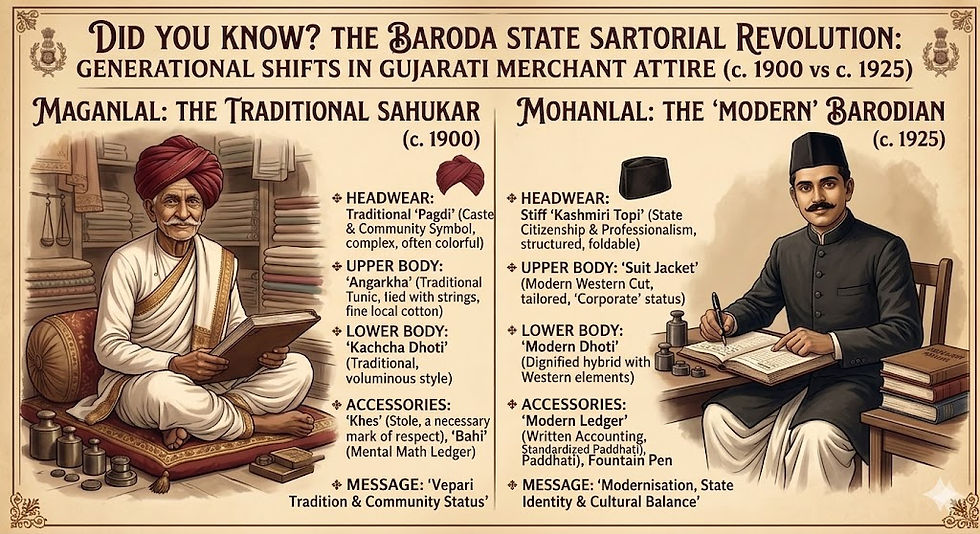
Bhikhalal (The Eldest): Raised in a world of pure tradition and the Victorian/Colonial era.
Mohanlal (The Youngest): Born into the dawn of modern Indian nationalism and a Baroda State that was rapidly building schools and libraries. This results in totally different views on education and the future for their own children.


Comments