The Origins of Dhoti and Suit Jacket Fusion in Indian Fashion History
- Sheel Shah
- Apr 17
- 6 min read
Updated: May 7
Fashion often tells stories beyond fabric and thread. One such story is the unique blend of the traditional Indian dhoti paired with a Western-style suit jacket. This combination, striking in its contrast, raises questions: Who decided this was fashion? Why mix half traditional and half modern attire? To understand this, we must travel back through generations and explore the cultural and political influences that shaped this style.
The Roots of Tradition: Magandada’s Era
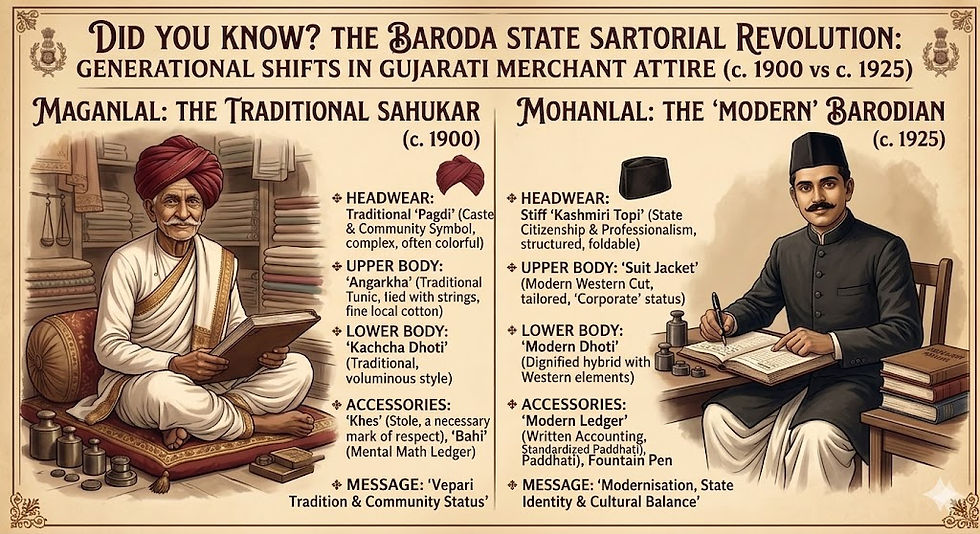
Imagine the 1800s, a time when Indian society was deeply rooted in tradition. Magandada, the grandfather’s father, likely dressed in the customary attire of his time. His clothing was probably entirely traditional, reflecting the values and norms of his community and era, which would be turban, dhoti, and traditional top. Change was slow, and fashion was not something to experiment with lightly. The dhoti, a long piece of cloth wrapped around the waist and legs, was a staple garment symbolizing cultural identity and comfort suited to the Indian climate.
Magandada’s style was set for life, and he did not alter it when his son, Mohandada, came of age.
Mohandada’s Style and the Unchanging Tradition
Mohandada lived through the 20th century, a period marked by rapid modernization and colonial influence. Despite these changes, he maintained his attire, distinct from his children’s evolving fashion choices. His style was a bridge between eras, holding onto tradition while subtly acknowledging the modern world.
The key to understanding Mohandada’s style lies in the influence of an earlier figure: Maharaja Sayajirao Gaekwad III of Baroda. The Maharaja’s choices in dress set a precedent that would ripple through generations, including Mohandada’s.
Maharaja Sayajirao Gaekwad III and the Birth of a New Fashion Path
When Maharaja Sayajirao Gaekwad III was granted full ruling powers in 1881, he initially wore the traditional Maratha royal dress. During his travels to Europe between 1887 and 1895, the Maharaja became convinced that traditional Indian royal dress was impractical for a modern administrator. He began wearing Western Sack Coats and Sherwanis during his travels. He realized that to be treated as an equal by British officials, he needed a dress that signaled "Order and Efficiency."
In the late 19th century, as British influence grew, Indian elites faced a visual dilemma: adopt full Western dress (which was seen as professional but culturally erasing) or adhere strictly to traditional clothing (which could be perceived by officials as a rejection of modernity).
Sayajirao III created a "middle path." By wearing a well-cut sack coat or sherwani-style jacket over a meticulously pleated Dhoti and topping it with a Maratha- or Gujarati-style pagdi, he visually communicated that a "Modern Indian" could master Western methodology, science, and statecraft while remaining rooted in Indian identity and tradition. Even as he adopted Western jackets, Sayajirao insisted on the Dhoti. To him, trousers were purely Western, but the dhoti was the "root."
Clothing Reform Reaches Bahadarpur
Between 1900 and 1910, the reform reached the people of Bahadarpur and Sankheda.
Baroda College (1900s)(now MS University): He mandated the "Baroda Uniform" (the suit jacket, dhoti, and stiff topi) for students. This ensured that the next generation of merchants, like Mohanlal, grew up seeing this as the mark of an educated man.
State Service Rules (1906): Official "Dress Regulations" were published in the Baroda Rajpatra (State Gazette), making the hybrid attire mandatory for all state employees (teachers in all the towns and villages funded by Baroda state, courts, railways, Bank of Baroda, other employees.
As a private merchant, Mohanlal wasn't an employee, but he was a "client" of all these institutions. So maybe he would dress this way to work with these individuals.
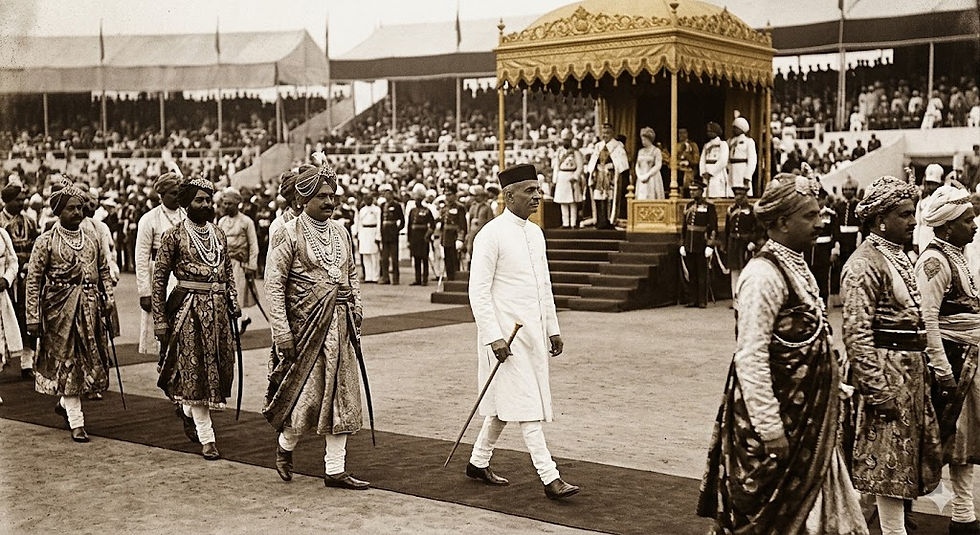
The most famous moment of his dress reform occurred at the 1911 Delhi Durbar.While other Maharajas wore heavy silk and millions of dollars in jewels to bow before King George V, Sayajirao walked in wearing a simple white cotton tunic and carrying a walking stick.
He proved that dignity came from simplicity and intellect, not "princely glitter." This event solidified the Stiff Topi and Plain Jacket as the ultimate symbols of Baroda's quiet nationalism.
Critics of the New Style
In the movie PK, the character wears chaniya (skirt) and suit top. He is laughed at - but on his end this was an accident. However, in Maharaja Sayajirao’s Baroda, there was a very serious political and social context behind the suit-and-dhoti look. It was purposeful. People absolutely made fun of it, though the reasons differed depending on who was doing the laughing.
The British were the most vocal critics. They viewed Western clothing as their exclusive "property."
"Babu" Caricature: British newspapers and cartoonists often mocked Indians who wore Western jackets with dhotis, calling them "half-civilized" or "Babus." They felt that if an Indian didn't wear a full three-piece suit (with trousers), he was failing at being "modern."

Underneath the laughter was fear. When a merchant like Mohanlal wore a sharp jacket, he was signaling that he was as professional as a British merchant. The British mocked the "hybrid" look to keep Indians in their place—either "fully traditional" (and therefore "backward") or "fully Western" (and therefore "colonized").
In villages like Bahadurpur, the older generation— perhaps even people in Maganlal’s circle — would have looked at the young men in jackets with a mix of confusion and sadness.
Older villagers might have jokingly called a young man "Chhota Sahab" (Little Master) or "Vilaayati" (Foreigner) when he first put on a suit jacket.
To some, the jacket symbolized a leaning toward the British. They might say, "He has the brains of a Gujarati but the skin of a Britisher."
Followers of the Swadeshi movement (especially later on, during Gandhi’s rise) sometimes mocked the Baroda elite for wearing "Western-cut" jackets.
They felt that even if the jacket was made of Indian cloth, the style was still an imitation of the oppressor. They preferred the simple, collarless Kurta or the Gandhi Cap over the "Stiff Baroda Topi" and the "Suit Jacket."
Despite the laughter from the British and the side-eyes from the elders, the trend stuck because Maharaja Sayajirao III made it "Cool" and "Powerful."
The Stiff Topi vs The Gandhi Topi: A Tale of Two Progressions
The period between 1938 and 1945 was the "fever pitch" of the Independence movement. In Gujarat, which was Gandhi’s home turf, the social pressure to switch to the Gandhi Cap and Khadi Kurta was immense.
During this time, two massive events reached deep into the Gujarat countryside:
The Haripura Session (1938): The Indian National Congress met in Gujarat. This brought thousands of activists into the region, all wearing the soft white Gandhi cap.
The Quit India Movement (1942): This was the "do or die" moment. In small towns, anyone wearing a Western-style jacket (like Mohanlal’s) might have been seen as a "loyalist" to the British or the old Princely order, rather than a "true patriot."
Mohandada’s decision to stick with his Stiff Topi and Jacket during these years was a very specific social stance.
The Swadeshi Agenda: Activists in Sankheda were likely holding bonfires of foreign-made cloth. They were pushing everyone to adopt the "Uniform of the Masses" (Khadi).
By keeping his Baroda attire, he was signaling that he believed in the Baroda Model of Progress. To him, being a "Modern Indian" meant being disciplined, educated, and professional.
He likely felt that the Baroda State had already given his family the tools to be free—education, trade, and law—long before the 1942 movement reached its peak.
There was often a subtle tension between the "Gaekwadi" identity and the "Gandhian" identity:
The Gandhian: Saw the Western jacket as a symbol of colonial influence.
The Gaekwadi (Mohanlal): Saw the jacket as a symbol of a Modern Indian State that was already more advanced than British India.
The Gandhi cap is a similar shape to Baroda topi. But, it’s made of hand-spun cotton, very soft, takes the shape of the person’s head and sits lower on their head. Mohandada’s Baroda cap is a bit stiff and sits higher on his head.
Final Thoughts on the Barodian Gentleman
While the rest of India shifted toward Gandhian simplicity or full Western suits after 1939, Mohandada never changed. To him, the jacket-and-dhoti was not a fashion choice—it was a soul-deep indoctrination of what it meant to be a "thinking" Barodian gentleman. Even through independence and international travel, he remained loyal to the Maharaja’s vision.


Comments