The Rise and Fall of the Touring Talkies: Movies Coming to Town on a Truck
- Sheel Shah
- Apr 17
- 3 min read
Updated: Apr 21

For a child growing up in the 1940s or 50s in Bahadarpur / Sankheda, there was no movie theater in town. They would watch movies in a Tambu — a massive waterproof tent that appeared like magic in an open field near the bazaar. Before there were cushioned seats and air conditioning, cinema was an event that smelled of woodsmoke, tasted of roasted peanuts, and arrived on the back of a motorized truck.
The Evolution: From Bullock Carts to Diesel Engines
The history of cinema in our family spans three distinct eras of technology: The Silent Era, Touring Talkies and Movie Theaters.
1. The Silent Era (Pre-1930s)
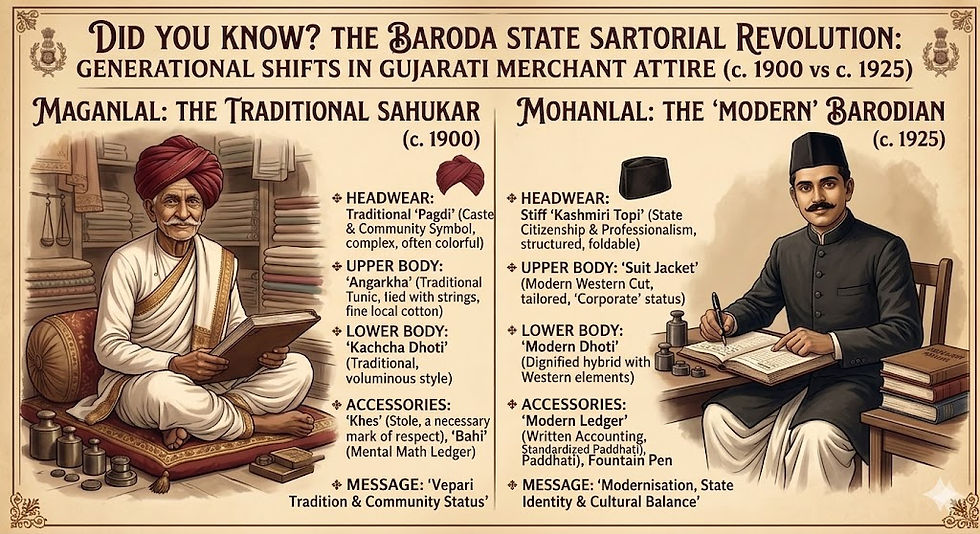
My great grandfather, Maganlal, likely witnessed the earliest form of cinema. These shows didn't arrive by truck, but by bullock cart. Early pioneers like Dadasaheb Phalke followed the "Haat" (weekly market) routes.
The Experience: Because these were silent films, they featured a Vyakhata (narrator) who stood by the screen explaining the story in Gujarati, accompanied by a live harmonium or tabla player.
The Magic: When films like Lanka Dahan (1917) played, people from nearby Bahadurpur would walk for miles, often prostrating before the screen, believing they were in the presence of the actual Gods.


2. The Golden Age of the "Touring Talkies" (1930s–1950s)
The arrival of reliable motorized trucks in the late 1930s changed everything. These trucks carried heavy diesel generators (the "bijli machine") and 35mm projectors. A truck would drive through the narrow lanes of Sankheda with a megaphone (bhongalu) blaring hit songs to draw the crowds toward the Orsang River fields.

The "Tambu" Economy: Seats for Every Class
Inside the tent, there were no numbered rows. Your "ticket" determined your comfort on the dirt floor:
The Pit (Ground Class): 25–50 Paise. You sat on a jute mat (taat-patti) or the bare earth.
The Bench Class: 75 Paise–1 Rupee. Long wooden benches at the back for a better view.
The Chair Class: 1.50–2 Rupees. A few folding chairs for the local elite, like wealthy merchants or the Sarpanch.
The Parda: A separate section for women, ensuring they could enjoy the "Safe Hits" like Sati Savitri or Narsinh Mehta in comfort.

The Sensory Experience: Peanuts, Soda, and Paan
In a Tambu cinema, the "background score" was often the constant crunch-crunch of people shelling roasted peanuts (Sing) and chickpeas (Chana), served in cones made of old school notebooks.
The Menu of the 1940s:
Lakoti Soda: The legendary Codd-neck bottle. You’d press the glass marble down with your thumb—POP!—and enjoy a fizzy Masala or Nimbu soda.
Gujarati Farsan: Wicker baskets filled with Gathiya and Sev. If the tent was near the bazaar, you might get hot Bhajiyas during the reel change.
The Intermission: In those days, the "Intermission" wasn't a scheduled break; it was simply the time it took the projectionist to swap the heavy film reels.
The Finale: The night wasn't over until the adults had a Paan from a stall outside, signaling the long walk home through the dark, quiet fields.

The "Release Lag" and the Bodeli Shift
We didn't see movies when they premiered in Bombay. In the 1940s, there was a significant "Release Lag." A film would play in Bombay, then Baroda, then "Stationary" theaters in towns like Dabhoi. By the time the celluloid canisters reached the Sankheda Touring Talkies—six months to a year later—the film was often scratched and faded. But to the audience in the tent, it was pure, new magic.
By the 1950s, the Bodeli Movie Theater appeared. It offered the "big city" experience: permanent seats and better sound. Sankheda residents would take a bus or train to Bodeli for the big Hindi blockbusters like Kismet (1943) or Goonj Uthi Shehnai (1959).
The Death of the Tent
The Tambu didn't die because of the Bodeli theater; it pivoted to religious films and the Mela (fair) circuit. It only truly vanished in the late 1970s and 80s when Television (Doordarshan) and the VCR arrived.
Once the magic could be captured on a small screen at home, the era of hauling waterproof tents through the mud of Gujarat came to an end. Today, the "crunch" of peanuts has been replaced by the rustle of popcorn bags, but the memory of that first "talkie" flickering against a cloth screen in a Sankheda field remains a cornerstone of our family’s journey into the modern world.

Comments